Osteopathy for Desk Workers: Easing Neck and Back Pain
Long hours at a screen leave many office workers with an aching neck, tight shoulders, and a stiff back. Here is why sitting loads the body the way it does, what you can change at your desk, and how osteopathy helps.
In this article
Why desk work loads the body
Stiff, aching necks and tired upper backs are among the most common complaints in a screen-bound working population — and for good reason. When you sit at a desk, your head drifts forward, your shoulders round in, and the muscles of the neck and upper back have to work continuously to hold the position. A forward-head posture loads those muscles far more than sitting tall, and holding any one position for hours on end fatigues them.
The result is a recognisable pattern: aching and stiffness across the neck, upper back, and shoulders that builds through the working day and often eases overnight, tightness between the shoulder blades, and sometimes a tension-type headache that starts at the base of the skull. It is cumulative, low-level strain rather than one dramatic event — which is exactly why it is so easy to ignore until it becomes a daily fixture.
It is not one “wrong” posture
There is a widespread belief that back and neck pain comes from sitting the “wrong” way, and that if you could just find the perfect posture the problem would disappear. That is not how it works. The issue is rarely a single bad position — it is holding any position for too long.
The most useful principle is a simple one: the best posture is the next one. A body that moves and varies its position through the day loads its tissues far more evenly than one held rigidly upright for hours. So rather than chasing a perfect ergonomic pose, the goal is to move often, change how you sit and stand, and break up long static stretches.
What you can change at your desk
A few practical adjustments make a real difference to how much your postural muscles are loaded across a day:
- Raise your screen so the top of the monitor sits around eye level, which keeps your head from dropping forward. A laptop on its own almost always sits too low — a stand plus a separate keyboard is a worthwhile fix.
- Support your arms. Resting your forearms rather than holding them out unsupported takes a surprising amount of load off the neck and shoulders.
- Build in movement. A short break every 30 to 45 minutes to stand, walk, or roll the shoulders resets the muscles before they fatigue.
- Vary your position. Alternating between sitting and standing, or simply shifting how you sit, spreads the load.
- Watch the extras. Long commutes, driving, and hours on a phone or tablet add to the same postural loading, so they count too.
These changes rarely undo an established ache on their own, but they stop it rebuilding once treatment has eased it — and that combination is what makes relief last.
How osteopathy helps
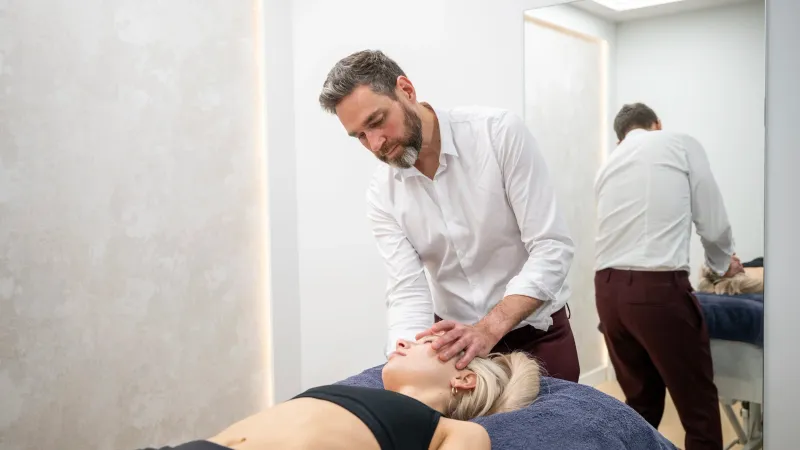
Osteopathy treats desk-related strain from both directions. Hands-on treatment eases the accumulated muscular tension and restores movement through the neck, upper back, and shoulders, so the day-to-day ache settles. Alongside that, Yousif Barr takes a whole-body view — because a stiff upper back or restricted shoulder can drive neck pain, and treating only the sore spot tends to leave the cause untouched.
At YB Osteopathy, the same session that eases the tension also gives you specific, practical advice on your workstation and habits, so the loading that caused the problem is addressed rather than left to rebuild. For recurrent or stubborn cases, The Full Body MOT — a head-to-toe screen of how you move and compensate — finds the upstream contributors a local approach can miss, and the Postural Assessment & Realignment pathway is built specifically for desk-bound professionals.
When to get it checked
Most desk-related neck and back pain is mechanical and not a sign of anything serious. But some symptoms deserve assessment before any hands-on treatment. Get checked promptly if you have weakness, numbness, or pins and needles spreading down an arm, if pain follows a significant fall or accident, or if symptoms come with problems affecting your balance, walking, or vision.
These features are uncommon, but they point to causes that need proper assessment first. Part of Yousif’s role at the initial appointment is to screen for exactly this — and to refer you on quickly through the in-house medical and wellbeing network at UNTIL if something falls outside osteopathic care.
Getting started at YB Osteopathy
YB Osteopathy is inside UNTIL at 111 Charing Cross Road, Soho (WC2H 0DT) — about a three-minute walk from Tottenham Court Road station, and convenient if you work in or around central London. Clinic days are Monday, Wednesday, and Thursday, 10:00 to 20:00.
An initial consultation and treatment is £125 and runs up to an hour: a full history, a whole-body examination, a working diagnosis explained in plain terms, and hands-on treatment. Follow-up appointments are 30 minutes. No GP referral is needed — you can book directly. If the desk-day ache has become part of your routine, it does not have to be.