Can Osteopathy Help Sciatica?
Sciatica is pain that travels from the lower back down the leg, and most cases settle over several weeks. Here is what sciatica is, what causes it, how osteopathy supports recovery, and the warning signs that need urgent medical care.
In this article
What sciatica actually is
“Sciatica” describes pain that radiates from the lower back or buttock down the back of the leg, following the path of the sciatic nerve. It is a symptom rather than a diagnosis in itself: the pain comes from irritation or compression of the sciatic nerve, or of the lumbar nerve roots in the lower spine that feed into it.
Typical sciatica affects one leg rather than both. Alongside the pain — which can be sharp, burning, or shooting — people often notice tingling, numbness, or a sense of weakness down the leg, sometimes as far as the foot. It can make sitting, standing from a chair, or bending uncomfortable, and it frequently flares after long periods in one position.
What causes it
Sciatica arises when something loads or irritates the nerve or its roots. Common contributors include changes in the lumbar discs, mechanical loading and stiffness through the lower back, and the sustained postures of a desk-bound life — long hours of sitting are a recognised factor. Muscular tension around the buttock and hip can also play a part in how the symptoms present.
In many cases no single dramatic cause can be pinpointed, which is normal and not a reason for alarm. What matters more than a precise label is how the pain behaves, whether there are any warning signs, and how it responds to movement and treatment — all of which a full assessment sets out to establish.
Can osteopathy help?
For most people with sciatica, the outlook is genuinely reassuring: symptoms tend to improve over several weeks, and the majority settle without injections or surgery. UK guidance for lower-back-related pain recommends staying active, exercise, and manual therapy as part of a package of care — and this is where osteopathy fits.
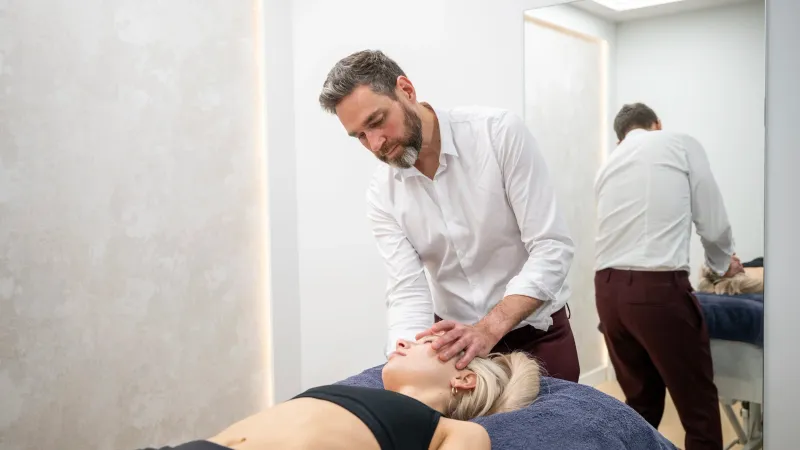
Hands-on osteopathic treatment aims to ease pain, reduce protective muscle tension, and restore movement through the lower back and hips, while a graded movement plan helps you stay active and rebuild confidence in the area. Yousif Barr takes a whole-body view — assessing how the lower back, pelvis, and hips move and load together — rather than treating only the site where you feel the pain. Osteopathy does not “cure” sciatica, and it is not right for every presentation; the value of the first appointment is a clear assessment of whether your symptoms are suited to hands-on care, or whether they point to something that needs medical input first.
What you can do yourself
While sciatica settles, a few principles help rather than hinder recovery:
- Stay as active as the pain allows. Prolonged bed rest tends to slow recovery, so gentle, regular movement and keeping to your normal routine where possible are recommended even during a flare.
- Keep walking. Short, frequent walks are usually better tolerated than long periods of sitting or standing still.
- Break up sitting. If you work at a desk, change position often and get up regularly rather than staying seated for hours.
- Pace, don’t push. Recovery is rarely a straight line; some days will feel better than others, and that is expected.
If simple measures are not helping, or the pain is limiting your daily life, an assessment can clarify what is going on and what will move things forward.
Red flags — when to seek urgent care
The great majority of sciatica is not dangerous, but a small number of symptoms need same-day medical assessment rather than osteopathy. Go to A&E or call 111 if you develop loss of control of your bladder or bowel, numbness around the saddle area (between the legs), or progressive weakness affecting both legs. These can indicate a rare but serious condition and should never be left.
You should also see a doctor if leg pain or weakness is severe and worsening, or if sciatica follows a significant injury. Screening for exactly these features is part of every initial osteopathy assessment, and Yousif will refer you on promptly through the in-house medical network at UNTIL if anything falls outside osteopathic care.
Seeing an osteopath in Soho
YB Osteopathy is inside UNTIL at 111 Charing Cross Road, Soho (WC2H 0DT), about a three-minute walk from Tottenham Court Road station. Clinic days are Monday, Wednesday, and Thursday, 10:00 to 20:00.
An initial consultation and treatment is £125 and runs up to an hour — a full history, a whole-body examination, a working diagnosis explained in plain terms, and hands-on treatment where appropriate. Follow-up appointments are 30 minutes, and no GP referral is needed to book. If pain has started travelling from your back into your leg, an honest assessment is the best place to begin.